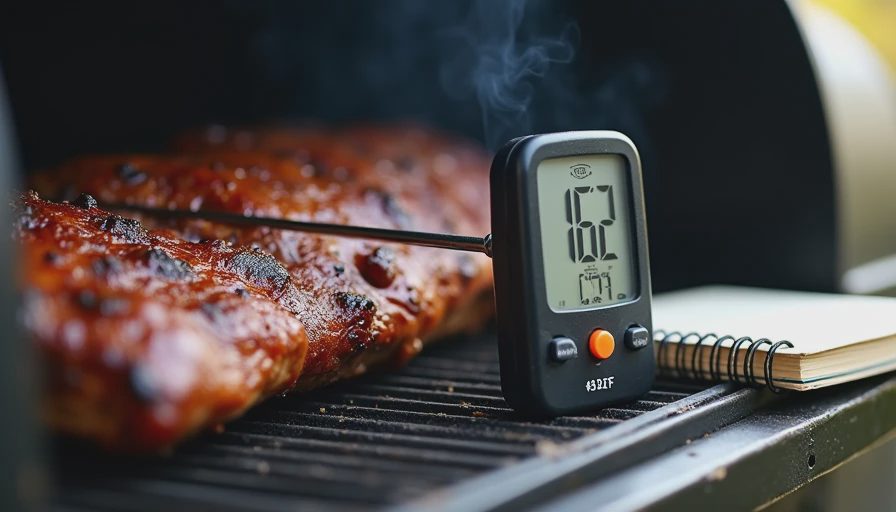
Low and slow, and don’t overthink it.
I used to treat the stall like a personal insult.
The cooker would be humming along at 250°F. The internal temperature of the brisket would climb steadily through the 140s and 150s. Then, right around 160–165°F, everything would flatline. For hours. Sometimes three. Sometimes five. The needle on the thermometer looked like it had taken the afternoon off.
My reaction was always the same: open the lid, add more fuel, bump the vents, wrap early, start calculating how late dinner was going to be. Every one of those moves made the cook worse. The stall was never the enemy. My panic was.
It took more ruined afternoons than I want to admit before I finally understood what was actually happening and, more importantly, what to do about it.
What the Stall Actually Is
When meat hits the stall, evaporative cooling takes over. Moisture from the surface of the meat turns into vapor and pulls heat away faster than the cooker can put it back. The internal temperature stops rising until the surface dries enough for the heat to start winning again.
It is physics, not failure. Every large cut does it. Brisket, pork butt, sometimes even thick ribs. The stall is the meat doing its job. Your job is to let it.
I wrote that sentence in the notebook after one particularly long Saturday and underlined it twice. It has saved more cooks since then than any new thermometer ever did.
How Panic Makes Everything Worse
Here is the pattern I used to follow, and the damage each step caused:
Lid opens → temperature drops → recovery takes longer
Extra fuel or higher vents → cooker spikes → bark sets too fast or dries out
Early wrap → bark softens and the meat steams instead of finishing clean
Constant checking → more lid time → more recovery time → deeper hole
Each panic move lengthens the stall or creates a new problem that looks like the stall’s fault. The notebook has pages of these spirals. The common thread is me refusing to sit still.
The Simple Rules That Finally Worked

I stopped trying to beat the stall and started planning for it. The change was mostly mental, but a few practical habits locked it in.
1. Expect it.
I now write the expected stall window into the timeline before I ever light the fire. If the meat hits 160°F at noon, I assume it might still be there at 3 or 4 p.m. That single expectation removes most of the urgency.
2. Leave the lid closed.
Unless the fire is actually dying or the temperature has crashed, I do not open the cooker during the stall. The recovery cost is almost never worth the information I think I need.
3. Hold steady heat.
I keep the cooker in the same 250–275°F range I started with. Chasing higher temperatures to “push through” usually just dries the surface faster and can make the stall longer.
4. Wrap only when the meat is ready, not when I am bored.
I still wrap many briskets and pork butts, but I wait until the probe starts to go in easier and the bark is where I want it. Wrapping at a fixed temperature because the stall is annoying is how I used to create soft, steamy bark.
5. Use the time.
The stall is the perfect window to prep sides, clean up, or actually sit down. I used to pace. Now I treat those hours as built-in break time. The meat is working. I do not need to.
A Real Cook That Proved It
Last fall I ran a 14-pound packer on a day when the stall lasted almost five hours. Old me would have been climbing the walls. New me checked the fire once, confirmed the cooker was steady, and went inside to help Sadie with a school project. When I came back the temperature had finally started climbing again. The finished brisket was one of the most even ones I had cooked all year.
The notebook entry was short: “Long stall. No panic. Best flat in months.”
That is the whole lesson in four words.
What Still Tempts Me
Even now, when the needle sits still longer than I planned, I feel the old urge to do something. Anything. The difference is that I recognize the urge and let it pass. I check the notebook instead of the lid. I remind myself that the meat is not broken. It is just busy.
Competition days still test this harder. The clock is real and the turn-in window does not care about physics. Even then, the cooks that score best are the ones where I stayed patient through the stall instead of trying to force the timeline.
The Only Enemy Left
The stall will happen. It will last longer than you want on some days and shorter on others. Weather, meat size, humidity, and cooker efficiency all play a part. None of those variables are under your complete control.
What is under your control is whether you turn a normal phase of the cook into a crisis. The moment you start chasing the temperature with lid time, extra fuel, or early wraps, you stop cooking the meat in front of you and start cooking your own anxiety.
I still write the stall down every time. I no longer write it in capital letters with three exclamation points. That change alone improved more meals than any new gadget on the market.
Low and slow, and don’t overthink it.
Especially when the thermometer is refusing to move and the only real problem is the person watching it.

No letters yet — be the first to write.